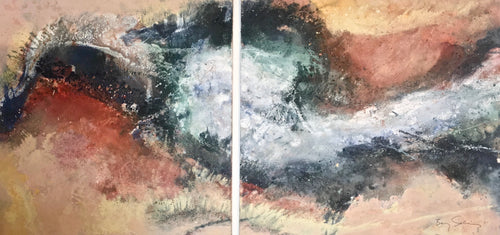
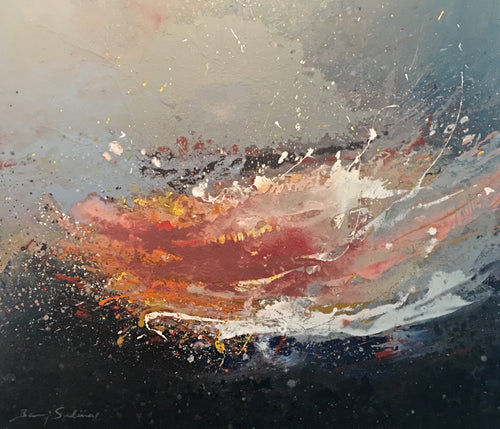
Collection: Baruj Salinas - A great Cuban Master

Baruj Salinas — A Master of Contemporary Abstraction


Baruj Salinas (1935–2024) stands among the most notable figures of postwar Latin American art and contemporary abstraction — an artist whose work bridged continents, disciplines, and generations while helping to shape the visual and intellectual landscape of modern diasporic art. Deeply informed by Abstract Expressionism, Salinas is widely regarded as having advanced the movement beyond its mid-century origins in New York into a distinctly international and transcultural language that resonated across the Americas, Europe, and the contemporary global art world into the 21st century.

Born in Havana, Cuba, and later establishing a lasting presence in Miami, Mexico City, and Barcelona, Salinas occupied a singular position within the history of contemporary art: at once an abstract painter, philosopher, educator, mentor, engraver, poetically minded intellectual, and cultural bridge between worlds. Although best known for his advancements in contemporary abstract painting, Salinas maintained a distinctly multidisciplinary practice that extended into printmaking, ceramics, textiles, stained glass, and mixed-media compositions, further reflecting the expansive intellectual and material scope of his artistry. Trained in architecture at Kent State University before pursuing painting in earnest, his work retained an architectural sensitivity to structure, spatial tension, and light. Yet it was through abstraction that Salinas achieved his most enduring artistic vision: luminous, meditative compositions balancing intellect and intuition, rigor and mysticism, subtlety and emotional force.

Pioneering a New Abstraction
Stylistically, rather than pursuing trends, Salinas created an internal visual language that evoked the universal, allowing his work to remain perpetually contemporary while maintaining a transcendental, human resonance. Positioned powerfully across both the 20th and 21st centuries, Salinas emerged as a vital bridge figure in international abstraction whose influence continues to grow with each reassessment of his career.

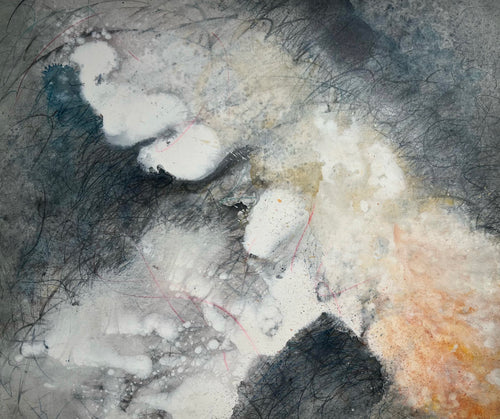
Salinas often described painting not as labor, but as an immersive, even spiritual act of "Zen" concentration and revelation. His acclaimed series Language of the Clouds—widely regarded as the body of work that brought Salinas broader international recognition and established his defining aesthetic—was shaped through his friendships and collaborations with major literary and philosophical figures including María Zambrano, José Ángel Valente, Michel Butor, and Pere Gimferrer. Language of the Clouds became one of the most consequential contributions to abstraction produced by a Cuban diasporic artist. Through it, Salinas developed a pioneering visual vocabulary that transcended linguistic boundaries while inviting profound contemplation. This new conceptual field of painting explored the infinite realm of suggestion and layered atmospheric subtleties by employing ethereal greys, translucent whites, nuanced color infusions, symbolic alphabets, and ambiguous pictograms. In doing so, Salinas dissolved the threshold between poetic figuration and expressive gesture through the enigmatic motif of clouds, advancing a metaphysical approach to painting that was rooted in diffuse and interpretative forms. 


The Language of the Clouds, 1982, from Salinas’ seminal Language of the Clouds series, widely recognized as one of Salinas' most formative bodies of work. Merging literary, philosophical, and conceptual influences with intuitive and mystical sensibilities, the series introduced a transcultural visual language distinguished by liminal tonalities and a restrained palette.  

International Cultural Influence
Throughout his career, Salinas cultivated close connections with many of the defining figures of 20th century modern art, including Joan Miró, Alexander Calder, Marc Chagall, Wifredo Lam, and Rufino Tamayo, as well as acclaimed Japanese print master Masafumi Yamamoto. These relationships situated Salinas within an extraordinary international cultural milieu, while reinforcing the multidisciplinary dimension of his practice. Reflecting their historical significance, many of their surviving correspondences have now found their way into the Smithsonian Archives of American Art for preservation and future scholarship.

Salinas played a pivotal role as a Cuban-American artist in elevating Cuban diasporic art and establishing Miami as one of the leading hemispheric centers for contemporary art. Long before Miami emerged as a globally recognized art market, Salinas was among the key artists laying its intellectual and cultural foundations. His influence extended not only through his exhibitions and institutional presence, but through generations of artists Salinas mentored and inspired. Among these was Juan González, whom Salinas helped introduce to the painting technique that later propelled González's celebrated rise within New York’s art scene. Salinas also co-founded Grupo GALA—the first known Latin American artist association in Florida—and later helped initiate the multinational abstract art collective 7 Plus One. For more than two decades, Salinas served as a Professor of Visual Art at Miami Dade College, where his impact as an educator shaped countless emerging artists and thinkers.

Institutional Recognition and Global Legacy
Over the course of an extraordinary career spanning more than six decades, Salinas exhibited internationally in over 150 solo exhibitions and became the recipient of numerous honors, awards, and distinctions across multiple disciplines. His work entered the permanent collections of more than 35 museums and institutions worldwide, including the Art Institute of Chicago, Museo Nacional d'Art de Catalunya, Phoenix Art Museum, San Antonio Museum of Art, Museo del Barrio (New York City), Fundació Joan Miró (Barcelona), Museo Rufino Tamayo (Mexico City), John and Mable Ringling Museum of Art, and numerous major collections throughout Europe and the Americas. His career was the subject of an internationally distributed book in three languages, a documentary film, several retrospective exhibitions, and published scholarly studies examining the depth and evolution of his artistic vision.

In the later years of his life, Salinas continued to reach new heights of cross-cultural recognition. In 2017, Salinas achieved a historic milestone through his commission for The Torah Project, later ceremonially presented to world leaders including German Chancellor Angela Merkel, Israeli President Reuven Rivlin, and the Monarchs of Spain and Sweden. On February 23, 2017, the first copy of the project was presented to Pope Francis at the Vatican. In an unprecedented moment of interfaith significance, Pope Francis performed the first documented papal blessing of a Jewish text. During the ceremony, Pope Francis also accepted five original works by Salinas into the Vatican’s permanent collection, placing the artist's work among those of renowned masters such as Michelangelo, Raphael, and Leonardo da Vinci. Salinas attended the occasion as an honored guest.


Penca, 1993, from Salinas’ landmark Penca de Palma Triste (Leaf of a Sad Palm) series, reflects his exploration of diaspora, memory, and layered symbolism through a distinctly emotive approach to abstraction. Regarded as emblematic of his return to the Cuban exile and Miami art communities following his Barcelona period, the work now resides in the Tampa Museum of Art's permanent collection.


Posthumous Reassessment
Since his passing in 2024, Salinas’ profile and institutional presence have continued to expand significantly, accompanied by a growing reassessment of his influence and historical importance. In 2025, the City of Coral Gables formally proclaimed “Baruj Salinas Day” as part of the city’s centennial year, recognizing him as one of Coral Gables’ “greatest cultural treasures” in acknowledgment of his enduring impact. His work entered the permanent collections of several major Florida institutions, including the Tampa Museum of Art in 2026 and the NSU Alvin Sherman Library, one of Florida's largest libraries, where his work was publicly unveiled alongside original work by Salvador Dalí in 2025. In announcing its acquisition, the Tampa Museum of Art described Salinas’ work as “an important chapter in the story of modern and contemporary art in the Americas,” further recognizing him among “the artists who have shaped the visual language of contemporary art.”

This expanding posthumous appreciation has heightened awareness of the scarcity of verified authentic Salinas works available on the market, further reinforcing his stature among serious collectors and institutions. Curator and critic Antonio Permuy has aptly described Salinas as a “quiet genius” — a characterization reflecting the profound dualities that continue to define both the artist and his legacy. Largely self-taught yet embraced by major academic and cultural institutions, Salinas occupied an unusual position within contemporary art: a private figure embodying diasporic migration who nevertheless moved fluidly among some of the leading artistic, literary, and intellectual circles of the 20th and 21st centuries. Rooted in the experience of exile and alienation, while simultaneously engaged in shaping cultural communities across multiple countries, Salinas existed both at the margins of identities and at the very center of significant artistic crossroads. His work mirrors these tensions: deeply introspective as well as universal, meticulous yet deeply intuitive, intellectually rigorous yet emotionally and spiritually resonant, historically grounded yet strikingly timeless. Though extensively exhibited, collected, and documented throughout his lifetime, Salinas' understated yet diligent persona retained an enduring sense of mystique that continues to distinguish his work and reputation from that of many of his contemporaries. 

Salinas in contemplation, later years.


For more than 20 years, MLA Gallery maintained an exceptionally close relationship with Baruj Salinas as his exclusive representative on the West Coast of the United States. Through this longstanding collaboration and specialized expertise, MLA Gallery remains the only gallery currently authorized to issue Certificates of Authenticity for Salinas’ works and can fully guarantee the authorship of its listed Salinas offerings. The gallery now proudly maintains an ongoing relationship with the Baruj Salinas Legacy Estate (BSLE), the sole institution dedicated to the documentation, preservation, scholarship, and public education surrounding Salinas’ life, career, and artistic impact.

Further Reading:

Salinas has work in the permanent collections of the following museums:


Art Museum of Ft. Lauderdale, Florida

Art Institute of Chicago, Chicago, Illinois

Arte del Siglo XX, Casa de la Asegurada, Alicante, Spain.

Bacardi Collection, Miami, Fl

Beit Uri Museum, Israel.

Biblioteca Nacional, Madrid, Spain.

Cabinet des Estampes, Geneva, Switzerland.

Cuban Museum of Art, Miami, Florida.

Fundacion Joan Miro, Barcelona, Spain.

Fundación Maria Zambrano, Velez-Malaga, Spain.

Fundacion Miguel Aleman, Mexico City

Institute of International Education, New York, NY.

Instituto de Cultura Puertorriqueña, San Juan, Puerto Rico.

Instituto Nacional de Bellas Artes, Mexico City

Musee Villa du Parc, Annemasse, France

John Ringling Museum of Art, Sarasota, Florida.

Lowe Art Museum (Cuban Collection) Coral Gables, Fl.

McNay Museum of Art, San Antonio, Texas.

Museo Alvar Carrillo Gil, Mexico City

Ayuntamiento de Soria, Spain

Museo Arte Contemporaneo LatinoAmericano (MACLA), La Plata, Argentina.

Museo Cuevas, Mexico City

Museo de Arte Moderno, Ibiza, Spain.

Museo de Arte Moderno, Mexico City

Museo de Villafames, Villafames, Spain.

Museo del Barrio, New York, NY

Museo Rayo, Roldanillo, Colombia.

Museo Rufino Tamayo, Mexico City

Museo Nacional D'Árt de Catalunya, Barcelona, Spain.

Museum of Art, Budapest, Hungary.

Museum of the Americas (OAS), Washington, DC.

Muskegon Museum of Art, Muskegon, Michigan.

Pemex Collection, Mexico City

Phoenix Museum of Art, Phoenix, Arizona.

Public Library, City of Miami, Miami, Florida.

San Antonio Museum of Art, San Antonio, Texas.

University of Ohio Museum of Art, Miami, Ohio.

Villa de Montecatini Collection, Italy

Museo Maria Zambrano, Velez-Malaga, Spain


MLA Gallery offers exceptional customer service and enjoys an outstanding reputation (please see our feedback on Google, Yelp, or Facebook). We have been around for 20 years, with a brick and mortar gallery near downtown Los Angeles. We always guarantee your satisfaction with the any work in the gallery, or your money back.

4 products
  • Baruj Salinas - White tongue
    Baruj Salinas - White tongue Art
    Regular price
    $41,000.00
    Sale price
    $41,000.00
    Regular price
    Unit price
    per 
    Sold out
  • Baruj Salinas - Sea Overture II
    Regular price
    $38,700.00
    Sale price
    $38,700.00
    Regular price
    Unit price
    per 
    Sold out
  • Baruj Salinas - Diagonal Fragment
    Regular price
    $42,700.00
    Sale price
    $42,700.00
    Regular price
    Unit price
    per 
    Sold out
  • Baruj Salinas - Astir
    Regular price
    $27,200.00
    Sale price
    $27,200.00
    Regular price
    $0.00
    Unit price
    per 
    Sold out
EU withdrawal